
Brexit, Borders & Belonging: Presenting “Diversity in EU Free Movement’’ at EUSA 2025
9th July 2025
Dr Fiona Costello

Image from EUSA website, available here: https://www.eustudies.org/
I am very grateful to the SLS for the RAF (Research Activities Fund) award which supported my attendance to the leading European Union Studies Association 19th Biennial International Conference, in Philadelphia, in May 2025.
The European Union Studies Association (EUSA) is a scholarly and professional association focused on the European Union, the ongoing integration process, and transatlantic relations. Founded in 1988, EUSA now has over 600 members throughout North America, all EU member states, and around the world. This year’s conference was hosted in the US, and as the opening paragraphs of the programme for the Conference state, ‘we come together at a dire moment in Transatlantic Relations’, a sentiment underlined by the US President’s statement earlier that year that the “EU was formed to screw the United States’’. The Chair noted that against this background the work of EUSA was more important than ever.
At the conference I shared our working paper entitled ‘Diversity in EU Free Movement: the experiences of minority ethnic Portuguese citizens in the UK, pre and post Brexit’ (co-authored with Professor Catherine Barnard) on the Panel EU Free Movement and EU Citizenship- Challenges from a Legal Perspective.
Our paper draws on extensive empirical work to examine the experiences of Black and Asian Portuguese citizens from both Portugal and those from former Portuguese colonies in Great Yarmouth and Lincoln. These EU citizens moved to the UK before Brexit, exercising EU free movement rights. Yet to date this group of Black and Asian EU nationals have largely been absent from the literature on free movement. Our paper therefore offers insights into the geographical reach of EU citizenship beyond the borders of the EU, particularly in the context of lusophone Africa, East Timor, and Brazil. It also examines the everyday legal problems experienced by these racially minoritised EU citizens: issues related to immigration status, experiences of discrimination and racism, as well as difficulties in accessing support from public bodies such as the NHS and local authorities. Our research highlights the extent to which public authorities are – or are not – delivering on their obligations under the public sector equality duty (PSED) laid down by the Equality Act 2010, a duty intended to ensure better outcomes for groups who share protected characteristics such as race and ethnicity.
The papers on our panel had a particular focus on those more marginalised within the EU citizenship discourse. For example, Dominika Harasimiuk (University of Warsaw, Poland) shared her research on ‘rainbow families’ and effective legal protection, Alezini Loxa (Lund University) about ‘migration and racial capitalism’, and Helga Luku (PhD Student, University of Antwerp) about ‘names, surnames and national identity’. Our panel was chaired by Ferdinand Wollenschlaeger (University of Augsburg) and the Discussant was Willem Maas (York University). We are incredibly grateful to William Maas whose comprehensive discussant feedback on our work was most thoughtful and detailed. We plan to revisit this paper in light of the useful feedback received and questions posed during the discussion period, and to submit it for publication later this year.
My attendance simply would not have been possible without the support from the SLS. And the benefits have been manifold. I have met colleagues and academics whose work I have been able to learn from and reference in my own work, developing my own knowledge and networks in the field, as an Early Career Researcher (ECR).
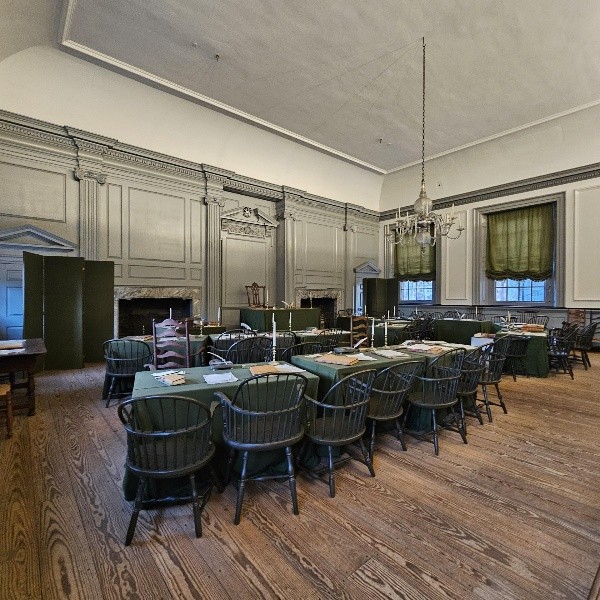
While at the conference, I took the opportunity to visit Philadelphia – the birthplace of American democracy. I visited Independence Hall which once housed all three branches of government in one place – legislative, executive and judicial – from 1732 to 1799. It was also the home of the U.S. Supreme Court from 1791 to 1800. During a time when there is increased focus on the US Constitution and the roles of the branches of government in the US, it felt a particularly striking moment to think back to the founding fathers sitting in the Assembly Room (pictured below) contemplating a document which would outlive them.
Assembly Room (Independence Hall)
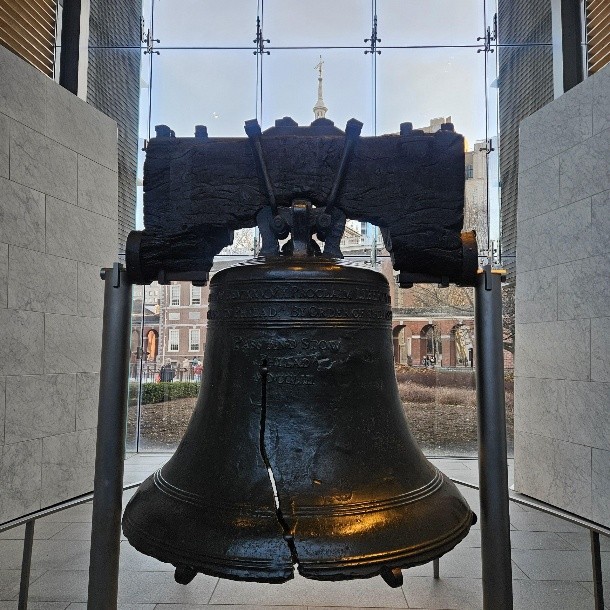
Liberty Bell
Pictures author’s own.